How Sharp Money Moves Betting Lines
How pro 'sharp' bettors move lines, create reverse line movement, and expose mispriced odds to find +EV bets.
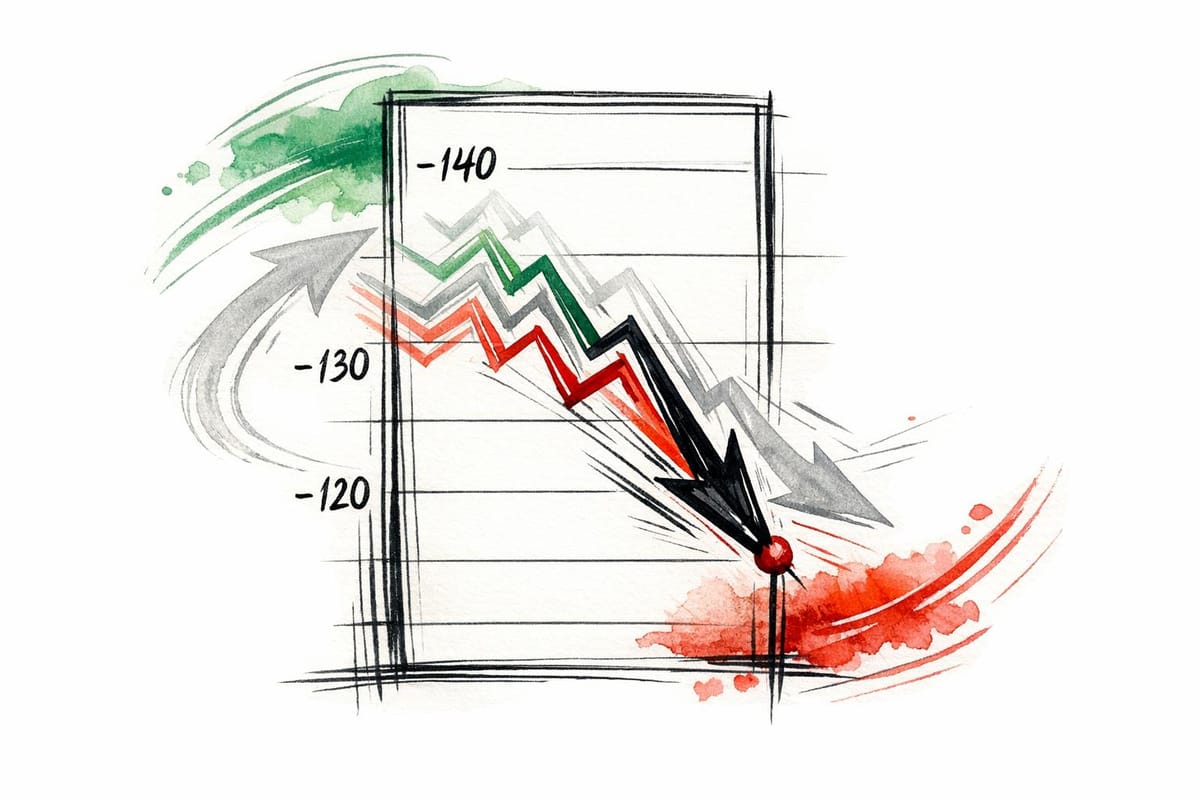
When sharp bettors - professionals using data and strategy - place large wagers, sportsbooks notice. These bets, known as sharp money, often cause immediate line adjustments, even if public bets lean the other way. Why? Sportsbooks trust sharp bettors' insights to avoid potential losses. For example, if a line moves from -3 to -4.5 despite 75% of public bets staying on the opposing side, it signals reverse line movement, a key sign of sharp action.
Sharp bettors bet early on opening lines for better value or wait strategically for key numbers. They use tactics like "head fakes" to manipulate lines or "buybacks" to capitalize on public-driven shifts. Casual bettors, driven by emotion or team loyalty, typically bet closer to game time and favor favorites or overs. Spotting sharp money trends - through reverse line movements, bet-to-money mismatches, or sudden shifts - can help you make smarter bets.
Tools like WagerProof analyze these trends in real time, offering insights into sharp money patterns, public betting data, and potential value plays. Success in betting comes down to discipline, data, and timing. By aligning with sharp money and focusing on mispriced lines, you can improve your results.
The Truth About Sharp Money & Steam Chasing | Unscripted with Bill Krackomberger
What Is Sharp Money?
Sharp money refers to bets placed by professional gamblers who approach sports betting as a calculated investment. These bettors rely on mathematical models and data analysis to identify pricing errors and find opportunities with positive expected value (+EV).
The key difference between sharp money and public money lies in the approach. Casual bettors often rely on media narratives, loyalty to specific teams, or gut instincts. In contrast, sharp bettors use disciplined, data-driven strategies. Sportsbooks recognize the importance of sharp wagers in their pricing process, often adjusting lines quickly when such bets are detected.
Characteristics of Sharp Money
Sharp bettors exhibit some distinct habits. Timing is one of the most important factors. They often place bets early, targeting opening lines before the market adjusts. Alternatively, they may wait until later, placing maximum-limit bets when a line reaches a specific value they find favorable.
Bet size is another indicator. Sharp money typically involves large, professional-level wagers, unlike the smaller bets associated with recreational gamblers. A useful way to spot sharp action is by identifying situations where a small number of bets account for a large percentage of the total money wagered.
Sharps also employ advanced tactics like the "head fake", where small early bets are used to manipulate lines, followed by larger wagers once the desired value is achieved. Another common strategy is "buybacks", where they bet heavily after public money moves lines to key numbers, such as 3 or 7 in NFL spreads.
Sharp Money vs. Public Money
The contrasting behavior between sharp and public bettors significantly impacts how sportsbooks manage risks. Sharp money helps determine the "true" price of a game, while public money - driven by emotions and biases - provides the volume that contributes to the sportsbook's edge. Even a small wager from a known sharp bettor can prompt immediate line adjustments, as these individuals consistently beat closing numbers.
| Feature | Sharp Money | Public Money |
|---|---|---|
| Primary Driver | Mathematical models and data | Emotion, media hype, and team loyalty |
| Bet Timing | Early (opening lines) or late bets | Closer to game time |
| Bet Size | Large, professional-level wagers | Smaller, recreational bets |
| Market Impact | Immediate, respected line changes | Gradual shifts to manage liability |
The difference in behavior also extends to where line movements occur. Market-making sportsbooks like Pinnacle or Circa, which accept high-limit bets and do not restrict winning players, are often the first to reflect sharp money. On the other hand, line shifts at retail sportsbooks such as DraftKings or FanDuel tend to reflect adjustments for public betting trends rather than sharp insights.
These patterns highlight the critical role sharp bettors play in shaping betting lines and market dynamics.
How Sharp Money Moves Lines
Opening Lines and Early Bets
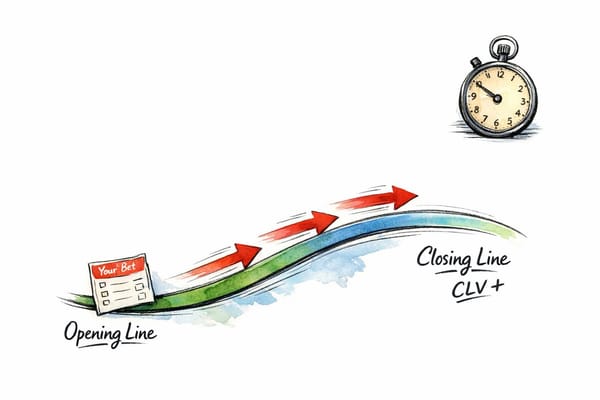
Sportsbooks release their opening lines several days ahead of an event, knowing these early numbers are particularly vulnerable to sharp bettors. These professionals rely on proprietary models to identify even the smallest discrepancies between the posted line and their calculated value. When they spot a mismatch - sometimes as minor as half a point - they act quickly, placing sizable bets before the market has a chance to adjust.
This timing is crucial. Sharp bettors target these "soft" lines well before the flood of public bets or media narratives begins influencing the market. High-limit, market-making sportsbooks are typically the first to post lines, making them a key battleground for sharp money. Early line movements at these books often reveal where sharp bettors are putting their money, prompting sportsbooks to make adjustments to protect themselves.
Line Adjustments from Sharp Action
When a sportsbook notices a respected bettor or account placing a wager, they respond immediately by moving the line. These adjustments reflect the trust sportsbooks place in sharp bettors, who consistently outperform the closing numbers. Ignoring sharp action would expose sportsbooks to potential long-term losses.
One clear indicator of sharp money is reverse line movement - when the line shifts in the opposite direction of the majority of public bets. Another is resistance at key numbers, particularly in NFL betting. For instance, numbers like 3 and 7 are critical because games often end with these margins. If public action suggests a line should move from –4.5 to –5.5 but it stalls, it often signals sharp money has already taken a strong position, and the sportsbook is hesitant to cross that key number.
Examples of Line Movements
Real-world examples highlight how sharp money influences line adjustments. Take Super Bowl LX (February 2026) as a case study: the Seattle Seahawks opened as 3.5-point favorites, but sharp action pushed the line to –4.5. Despite Seattle attracting 55% of spread tickets and 61% of the spread money, sportsbooks chose not to move the line further. Instead, they adjusted the juice to manage their risk.
In the same game, a sharp-facing sportsbook took a $1.1 million wager on the Patriots at +188 in the moneyline market. This forced sportsbooks to tighten New England's odds, even as the public heavily backed Seattle. Similarly, the over/under total dropped from 46.5 to 45 after professionals identified value on the Under. These examples underscore how sharp money can shape the market, even when public betting trends suggest otherwise.
Tools for Tracking Sharp Money
Indicators of Sharp Money
Identifying sharp money involves spotting patterns that hint at professional betting activity. One of the most reliable signs is reverse line movement (RLM). This happens when the betting line shifts in the opposite direction of public wagers - indicating that sharps are betting heavily enough to outweigh the public's volume. Sportsbooks respect the sharp bettors' insights more than public sentiment, so they adjust lines accordingly.
Another useful metric is comparing bet percentages to dollar percentages. Sharp action often shows a smaller percentage of bets but a larger percentage of the money wagered. For example, a sharp play might have only 25% of total bets but account for 45% of the money. This mismatch highlights how sportsbooks manage risk and respond to sharp action.
Keep an eye on sudden line shifts, especially shortly after lines open. Sharps often exploit early lines they believe are mispriced before the public catches on. For instance, if the Jets open at -5.5 and quickly move to -6 with minimal betting volume, it’s a sign sharps are targeting an edge. Over time, sharp bettors maintain a long-term win rate of 55%, which allows them to profit even at -110 odds, where the break-even point is 52.4%. Recognizing these movements is key to understanding sharp money trends.
Using WagerProof to Track Sharp Money
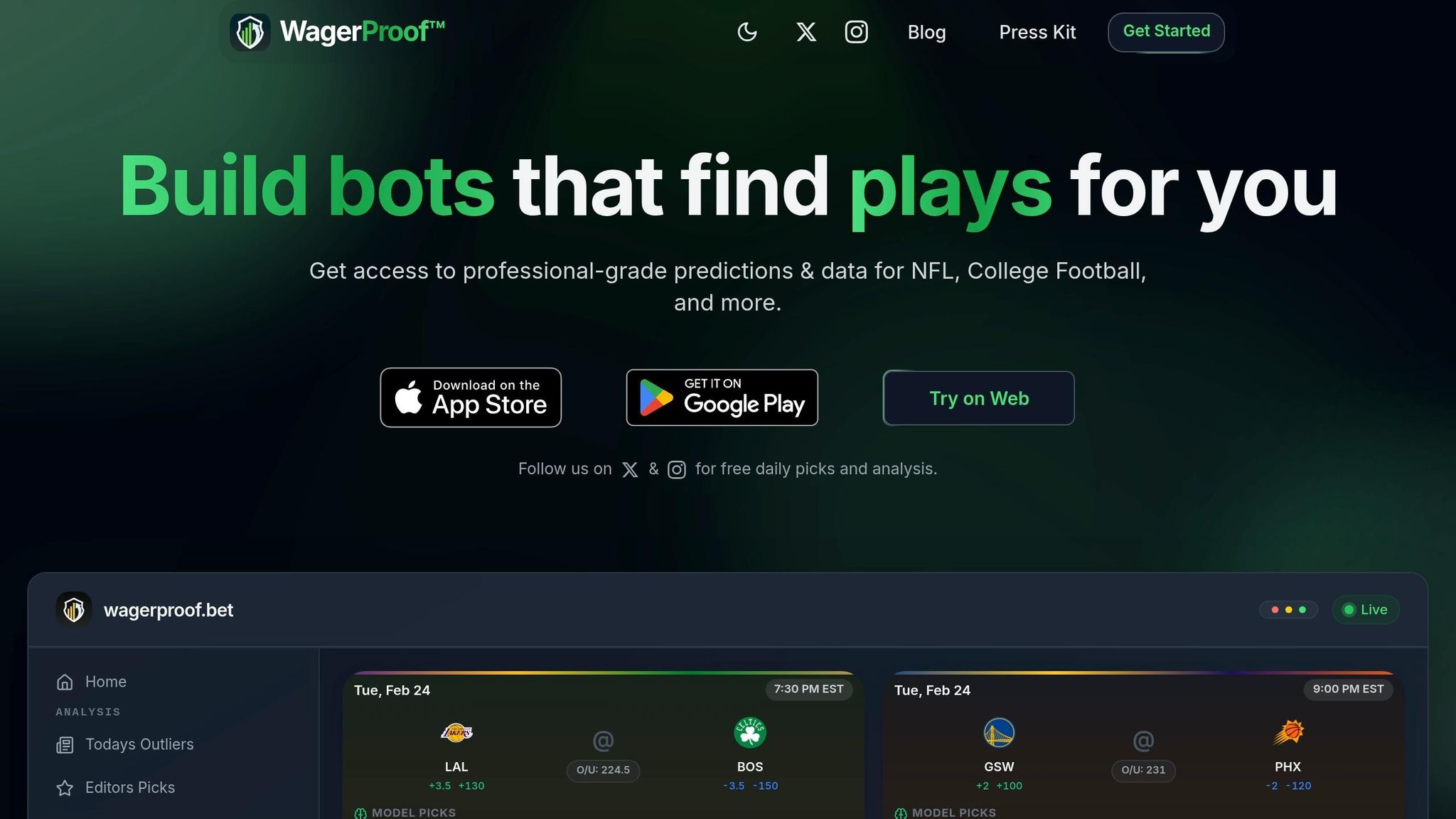
Advanced tools like WagerProof take these indicators to the next level by analyzing them in real time. WagerProof's AI research agents continuously monitor sharp money patterns, crunching historical data, and identifying discrepancies between public bets and money distribution. Users can customize these agents with over 50 adjustable parameters, such as risk tolerance, preferred sports, and betting style. The platform highlights prediction market mismatches, where betting lines deviate from statistical models, and sends outlier alerts for potential value bets that might go unnoticed elsewhere.
The WagerBot Chat feature offers instant insights by answering questions like, "Is this reverse line movement sharp?" It pulls live data - odds, injuries, weather, and model predictions - into a detailed analysis. For example, if there’s steam on an underdog, WagerBot might provide a response like, "Eagles +2.5 sharp value pre-Super Bowl line move", and suggest whether to follow the sharp money or avoid public bias. It also flags conflicts between high-stakes wagers and ticket counts, giving users the same real-time insights sportsbooks use to adjust their lines.
Sharp Money vs. Public Money: Comparison
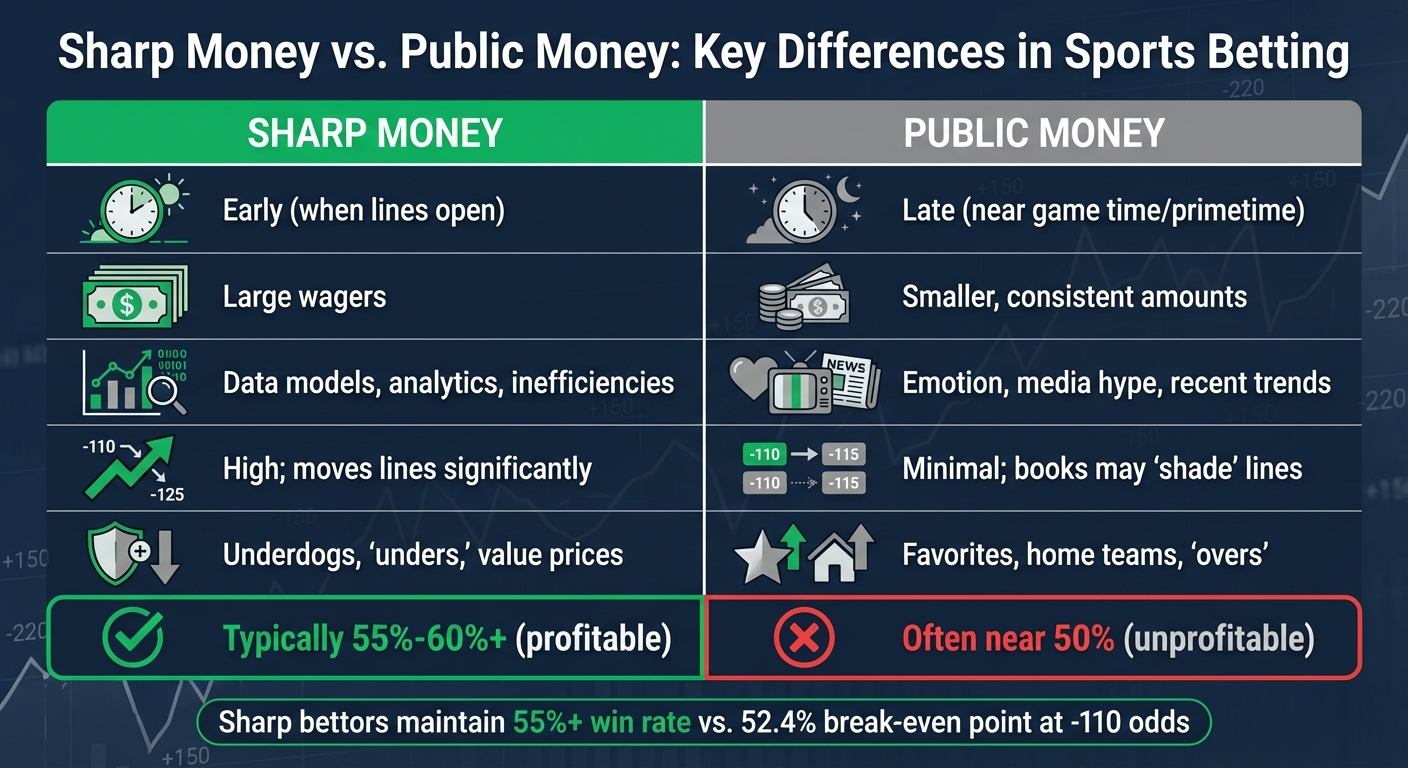
Sharp Money vs Public Money: Key Differences in Sports Betting
The difference between sharp and public money plays a key role in how sportsbooks adjust their lines. Sportsbooks pay closer attention to sharp money because it comes from professional bettors and syndicates who rely on advanced data models to spot market inefficiencies. Instead of trying to predict outcomes, sportsbooks focus on managing financial risk, which is why sharp bets are weighted more heavily.
Timing is another critical factor. Sharp money tends to hit the market early, taking advantage of softer opening lines. On the other hand, public money usually pours in closer to game time. When sharp money and public money conflict, sportsbooks often side with the professionals, leading to reverse line movement. For example, a single substantial wager from a known sharp bettor can shift a line more dramatically than a large volume of smaller public bets.
Public bettors often lean toward favorites, home teams, and betting the "over", which can create pricing inefficiencies. While casual bettors typically hover around a 50% win rate - unprofitable when factoring in the standard -110 odds - sharp bettors usually maintain win rates between 55% and 60% or higher, keeping them consistently in the black.
Side-by-Side Comparison
| Feature | Sharp Money | Public Money |
|---|---|---|
| Timing | Early (when lines open) | Late (near game time/primetime) |
| Bet Size | Large wagers | Smaller, consistent amounts |
| Decision Basis | Data models, analytics, inefficiencies | Emotion, media hype, recent trends |
| Line Impact | High; moves lines significantly | Minimal; books may "shade" lines |
| Preferred Sides | Underdogs, "unders", value prices | Favorites, home teams, "overs" |
| Win Rate | Typically 55%–60%+ (profitable) | Often near 50% (unprofitable) |
This dynamic is why tools like WagerProof focus on analyzing these trends in real time. For instance, when the Chiefs opened as -7 favorites against the Broncos, 80% of public bets supported Kansas City. Yet, the line shifted to -6.5 - a clear sign that sharp money was backing the Broncos. This example highlights how sportsbooks prioritize professional betting activity over casual betting volume.
Conclusion
Knowing how sharp money influences betting lines can help you make smarter wagers. Sharp bettors typically win about 55% of their bets. By spotting signs of sharp action - like reverse line movements, steam moves, and mismatches between bets and dollars - you can align your strategy with the pros instead of following the crowd.
That said, don't blindly rely on sharp money. Use it to confirm your own analysis. If your research points to value on a side that's also drawing sharp action, you've likely found a stronger opportunity. Keep an eye on how lines shift in relation to public betting percentages, and always shop around at multiple sportsbooks to find the best odds.
WagerProof can be a valuable tool for this process. It provides real-time data, including public betting percentages, money distribution, and prediction market insights, along with automated alerts for sharp action. Its AI-powered research agents analyze games around the clock, while WagerBot Chat delivers live updates - like odds, injuries, weather, and model predictions - into actionable advice without guesswork. These features can fit seamlessly into your betting strategy, helping you identify mispriced lines before sportsbooks adjust.
Success in sports betting comes from discipline and analysis, not luck. By studying sharp money trends and leveraging tools that highlight market inefficiencies, you can focus on finding bets with positive expected value. Even if you don't hit the 55% win rate of sharp bettors, understanding these patterns can significantly boost your results compared to casual betting.
The key is to spot mispriced lines before the market corrects, bet only when you have a real edge, and let data drive your decisions. This methodical approach, built on sharp money insights, can redefine how you approach sports betting.
FAQs
How can I tell sharp money from public money?
Sharp money refers to bets placed by professional gamblers who rely heavily on data and analysis to make their decisions. These wagers are usually made early and can lead to line movements that often contradict popular opinion. On the flip side, public money is driven by casual bettors who tend to place their bets later, swayed by factors like emotions, team popularity, or recent performances. While sharp money often highlights potential value, public money tends to showcase general betting trends.
What is reverse line movement, and why does it matter?
Reverse line movement (RLM) occurs when a betting line moves in the opposite direction of where the majority of public bets are being placed. In simpler terms, even though most people are betting on one side, the line shifts to favor the other side. This usually signals that sharp bettors - those with deep expertise and large wagers - are putting their money on the less popular side, forcing sportsbooks to adjust the odds.
Why does this matter? RLM can reveal where the "smart money" is going. Following these shifts can help bettors spot opportunities that align with professional insights, potentially leading to better, more informed betting decisions.
When should I bet to get the best number?
When you want to secure the best odds, it's smart to place your bets early - right when sharp money begins to impact line movement. Acting at this time allows you to lock in better numbers before sportsbooks make adjustments based on market shifts.