Consistency vs. ROI in Betting Models
How to weigh consistency, CLV and ROI in betting models—when win rate matters, when ROI wins, and how AI helps.

Consistency and ROI are two key metrics for evaluating betting models. Consistency measures how often predictions align with actual outcomes, while ROI (Return on Investment) calculates profitability as a percentage of total wagers. Both are essential for long-term success, but they serve different purposes:
- Consistency: Focuses on accuracy. For example, if a model predicts a 70% win probability, outcomes should match that over time. Metrics like win rate (e.g., 55%-60% for -110 odds) and Closing Line Value (CLV) are used to assess it.
- ROI: Measures financial performance. A 10% ROI means earning $10 for every $100 wagered. Professional bettors aim for 2%-5% ROI over thousands of bets.
Key Takeaways:
- Consistency matters more in the short term (e.g., <1,000 bets) to ensure accuracy and identify patterns.
- ROI becomes critical over larger samples (e.g., >1,000 bets) to confirm profitability.
- Balancing both metrics is crucial. High consistency without ROI can mean poor odds, while high ROI without consistency may indicate luck.
Tracking both metrics side by side helps refine strategies, avoid variance pitfalls, and achieve sustainable betting success. Tools like AI for sports betting predictions streamline this process by analyzing data, identifying value bets, and ensuring disciplined risk management.
The BIGGEST Lies in Sports Betting (I Made $62,000 This Month Avoiding Them) #sportsbets
What is Model Consistency?
Model consistency evaluates how well a model's predicted probabilities align with actual outcomes. For instance, if a model predicts a 70% chance of an event happening, that event should occur about 70% of the time. This concept helps determine whether a model’s probability estimates are accurate reflections of reality.
Consistency goes beyond short-term results. A model might deliver impressive profits in the short run, but consistency helps distinguish between genuine predictive skill and simple variance. Professional bettors rely on this metric to determine if their perceived edge is real or just a result of chance.
One of the best ways to assess consistency is through Closing Line Value (CLV) - a measure of how often you secure better odds than the final market price before a game begins. For professional bettors, consistently beating the closing line is a key indicator of long-term success. Why? Because the closing line reflects all available information at game time. If your model consistently identifies value earlier, it’s a sign of genuine predictive ability.
Here’s a striking stat: only 3% to 5% of sports bettors consistently beat the market over time. This highlights why consistency is far more important than occasional big wins. Anyone can get lucky over a small sample of 50 or 100 bets, but maintaining an edge across thousands of wagers requires a solid, reliable approach.
Next, let’s explore how consistency is measured.
How to Measure Consistency
The go-to metric for consistency is the win rate - the percentage of bets your model wins. For standard -110 odds (common for point spreads or totals), you need to win about 55% to 60% of your bets to turn a profit after factoring in the sportsbook’s commission.
Another critical factor is sample size. While ROI can fluctuate wildly over a few hundred bets, a sample of 1,000 or more wagers is typically needed for results to stabilize and provide meaningful insights.
Among all metrics, Closing Line Value is the most reliable benchmark for consistency. Securing a 2% to 5% edge over the closing line can translate into a significant boost in annual ROI - potentially increasing returns by 15% to 25%. Unlike win rate, which can be influenced by individual game outcomes, CLV focuses on comparing your entry price to the market’s final assessment, cutting through the noise.
Pros and Cons of Consistency
Now that we’ve covered how to measure it, let’s look at the strengths and weaknesses of focusing on consistency.
The biggest advantage of consistency is its ability to reveal reliable patterns for long-term success. A model with strong consistency metrics shows that its predictions align with actual outcomes, not just lucky streaks. This reliability helps bettors stay confident during inevitable losing stretches and avoid chasing bad bets to recover losses.
But consistency isn’t perfect. For one, it doesn’t account for bet size or odds, which are crucial to overall profitability. For example, a model might maintain a solid 58% win rate at -110 odds, but if it occasionally recommends large bets on +300 underdogs that rarely win, the bankroll can still take a hit despite strong consistency metrics.
Another challenge is the need for large sample sizes to properly evaluate consistency. Without sufficient data, even a seemingly consistent model can produce misleading results. To navigate the natural variance that even consistent models experience, bettors should stick to strict bankroll management - risking only 1% to 3% of their bankroll per wager. This discipline ensures survival during inevitable downswings.
Understanding consistency sets the stage for comparing it with ROI, the next key metric in evaluating betting performance.
What is ROI in Betting Models?
While consistency measures how accurate predictions are, ROI (Return on Investment) dives straight into profit efficiency, showing exactly how much money you’re making relative to the risk you’re taking.
ROI is expressed as a percentage and calculated using this formula: (Net Profit / Total Wagered) × 100. Let’s break it down with an example. If you bet $2,000 over a season and end up with a $200 profit, your ROI is 10%. That means you’re making 10 cents for every dollar you risk.
Here’s the reality check: only 3.2% of tracked sports bettors maintain a positive ROI after 12 months. And if you can consistently achieve an ROI between 2% and 5%, you’re in the top 1.5% of tracked accounts. Beating the betting market isn’t easy - it’s a challenge even for the most seasoned bettors.
Wagered-Based vs. Bankroll-Based ROI
Professional bettors often differentiate between two types of ROI: wagered-based and bankroll-based.
- Wagered-Based ROI focuses on your efficiency, showing how much profit you make per dollar risked. It’s the most commonly used metric for comparing betting performance.
- Bankroll-Based ROI tracks the growth of your total investment capital, offering a broader view of how your bankroll evolves over time.
Both metrics are useful, but wagered-based ROI is the gold standard for evaluating betting strategies.
Accounting for the Vig
To calculate ROI accurately, you need to subtract the vig (the sportsbook’s commission). For example, on a standard -110 line, the vig is about 4.55%. This means you need a win rate of roughly 52.4% just to break even (0% ROI). Without factoring in the vig, your ROI calculation could give you an inflated sense of profitability.
How to Calculate ROI
The formula is simple: (Net Profit / Total Wagered) × 100. Let’s put it into action:
- Say you place 200 bets at $10 each, totaling $2,000.
- At standard -110 odds, a win returns about $19.09 (your $10 stake plus $9.09 profit).
- If you win 116 bets and lose 84, your wins generate approximately $1,055 in profit (116 × $9.09), while your losses cost $840 (84 × $10).
- Your net profit is $215, leading to an ROI of (215 / 2000) × 100 ≈ 10.75%.
This level of ROI would be outstanding, especially given how tough it is to consistently outperform the market.
To ensure accuracy, always include every dollar risked - vig included - when calculating ROI. Skipping this step could make your results look better than they actually are.
Pros and Cons of ROI
One of ROI’s biggest strengths is its focus on profitability. A high win rate doesn’t guarantee success if the odds don’t justify the risk. Conversely, a lower win rate can still lead to strong profits if the payouts are high enough. ROI captures this balance, making it a more reliable measure than win rate alone.
ROI also allows you to objectively compare different betting strategies. For example, a model with a 3% ROI is more profitable than one with a 1% ROI, regardless of differences in win rate or the number of bets placed.
However, ROI isn’t perfect. It’s highly sensitive to sample size and variance. Over a small number of bets, a few big wins or losses can cause your ROI to swing dramatically. Additionally, ROI doesn’t account for risk or volatility. A 5% ROI from betting on high-risk underdogs involves very different bankroll fluctuations compared to a 5% ROI from safer bets on spreads.
Up next, we’ll explore how consistency and ROI work together to shape long-term betting success.
Consistency vs. ROI: Direct Comparison
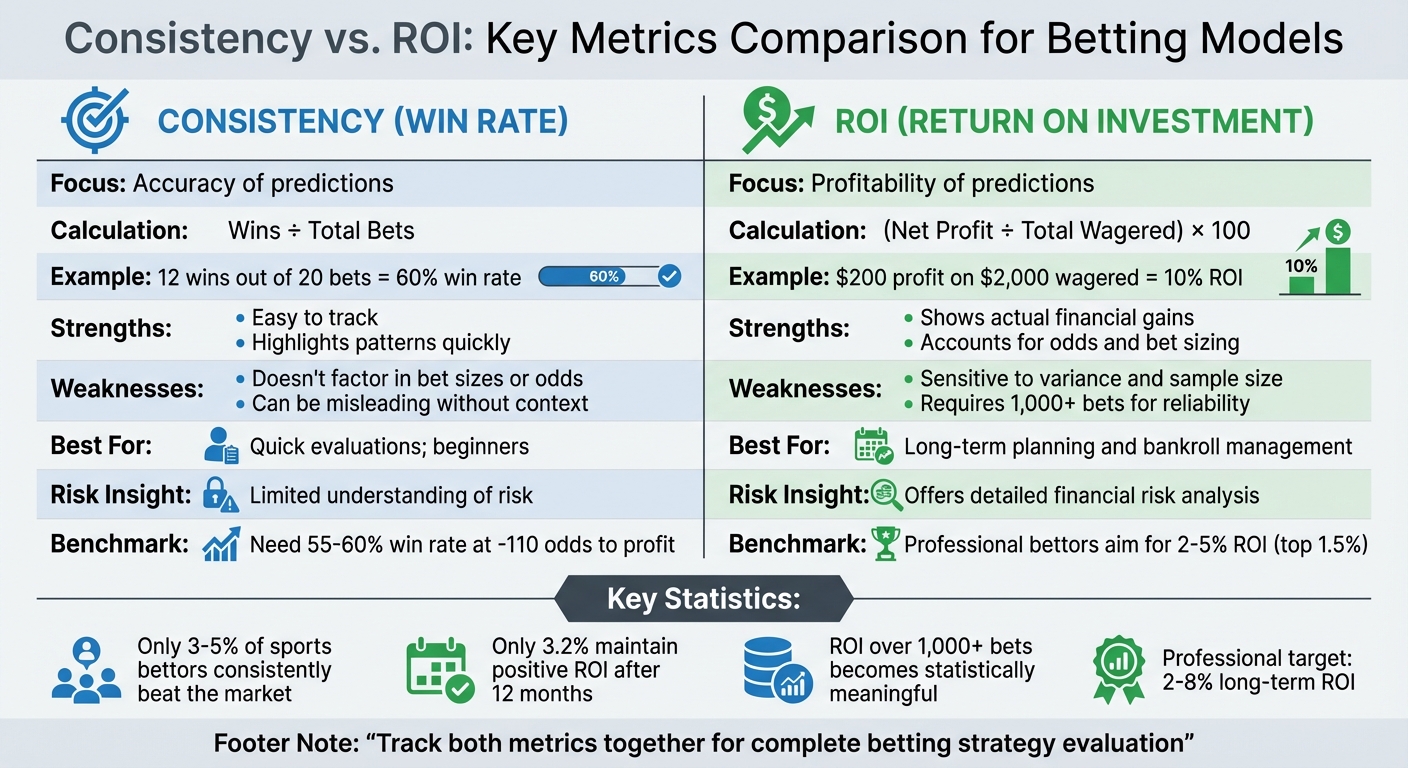
Consistency vs ROI in Betting Models: Key Differences and Metrics
Let’s break down the comparison between consistency and ROI. Consistency measures how often your predictions are correct - essentially answering, "Am I getting it right most of the time?" On the other hand, ROI (Return on Investment) evaluates the profitability of those predictions by asking, "How much money am I actually making from this?" [6, 11]
Here’s the catch: a high win rate (like 60%) doesn’t always mean you’re making money if the odds are too low. Meanwhile, a lower win rate (like 45%) can still deliver profits if you’re betting on undervalued opportunities. By examining both metrics together, you get a clearer picture of whether your betting strategy is working in the long run.
Comparison Table: Key Differences
| Aspect | Consistency (Win Rate) | ROI (Return on Investment) |
|---|---|---|
| Focus | Accuracy of predictions | Profitability of predictions |
| Calculation | Wins ÷ Total Bets | (Net Profit ÷ Total Wagered) × 100 |
| Strengths | Easy to track; highlights patterns | Shows actual financial gains; accounts for odds |
| Weaknesses | Doesn’t factor in bet sizes or odds | Sensitive to variance and sample size |
| Best For | Quick evaluations; beginners | Long-term planning and bankroll management |
| Risk Insight | Limited understanding of risk | Offers detailed financial risk analysis |
What the Comparison Shows
The table highlights how each metric serves a different purpose. Consistency gives you a fast snapshot of how accurate you are - if you win 12 out of 20 bets, your win rate is 60%. But here’s the thing: that number doesn’t tell you if those wins are actually profitable. That’s where ROI steps in, focusing on your financial returns. For example, a 7% ROI - earning $7 for every $100 wagered - is considered excellent, especially since only about 3% of bettors consistently achieve positive ROI over time.
The best strategy? Track both metrics side by side. If you see high consistency but low ROI, it might mean you’re winning often but betting on poor odds. On the flip side, a moderate win rate with high ROI suggests you’re spotting value bets. When both metrics improve steadily over a large number of bets, you’ve likely found a method that’s ready to scale.
When Consistency Matters More
When dealing with smaller sample sizes, consistency becomes far more important than ROI. Why? Because with only 50 to 100 bets, ROI can be skewed by random fluctuations and variance. For instance, a 15% ROI over just 50 bets is likely more a stroke of luck than a sign of a genuine edge. As EquinEdge highlights:
"ROI over 50 bets tells very little; ROI over 1,000+ bets becomes statistically meaningful."
Even after 1,000 bets, ROI can still fluctuate significantly, ranging from -5% to +12%. It often takes more than 3,000 bets for ROI to settle into a reliable pattern. This is why early indicators like win rate and how well predicted outcomes align with actual results are so valuable - they provide immediate feedback on whether your approach is on the right track.
This focus on consistency is especially crucial for certain betting strategies. Take low-payout strategies with high win rates, for example. If you're betting on favorites with odds like -200 or -300, you need to win frequently just to break even. A 65% win rate might look good on the surface, but if your ROI is barely positive, it could signal that you're not capturing enough value.
Consistency acts as an early-warning system. By keeping an eye on how closely your predictions match actual outcomes, you can quickly gauge whether your model is reliable. Professional bettors often aim for a long-term ROI of 3–6%, with anything above 10% being extremely rare and difficult to sustain at scale. Before reaching the 1,000-bet mark, tracking consistency metrics can help you decide whether to stick with your model or make adjustments. In short, monitoring consistency early on is key to making smarter, long-term strategic decisions.
When ROI Shows the Real Picture
While consistency provides early clues, it's ROI that ultimately reveals whether your betting strategy is truly profitable. Once you've placed over 1,000 bets, ROI becomes the definitive measure of success. A high win rate might seem promising, but it doesn't always equal profit. For example, a bettor hitting 60% of bets on -200 favorites might still lose money, whereas someone winning just 40% of bets on +180 underdogs could see significant gains. ROI bridges the gap between initial predictive accuracy and actual financial returns.
Key factors like bet sizing, commission fees, and odds play a crucial role in shaping ROI. These are elements that win percentage simply doesn’t account for. If your bets consistently favor heavy favorites at -200 or worse, you'll need an even higher win rate to offset the inherent disadvantages. As Sports Command aptly states:
"Win rate alone is nearly meaningless."
The reality is stark: only 3.2% of bettors report a positive ROI after a year of betting. Professional bettors typically achieve long-term ROIs of 2% to 8%, and sustaining an ROI between 2% and 5% over 1,000+ wagers places you in the top 1.5% of tracked accounts. Even bet sizing strategies matter - a fixed-percentage staking approach (1–3% of your bankroll) has been shown to produce ROI figures that are, on average, 1.8 percentage points higher than flat-dollar betting, even when pick accuracy is identical.
ROI also highlights whether you're focusing on the wrong type of consistency. A strong win rate paired with a negative ROI often signals that you're betting on unfavorable odds. This is particularly common with parlay-heavy strategies or prop bets, where the vig is higher. ROI cuts through the noise, showing the real financial impact of your approach and emphasizing the importance of balancing both metrics as you refine your betting strategy.
Tracking Both Metrics with WagerProof AI Agents

Trying to balance consistency and ROI manually is a time sink. Traditional methods can take anywhere from 30 minutes to hours per game and usually only track 10–15 metrics at best. WagerProof's AI agents, on the other hand, analyze thousands of data points in real time, offering a way to monitor both metrics simultaneously. This level of automation opens the door to more effective betting strategies.
How AI Agents Track Both Metrics
WagerProof's AI agents come equipped with over 50 adjustable parameters, allowing you to fine-tune them to fit your risk tolerance, preferred sports, and betting style. These agents constantly analyze matchups, generate picks, and track both consistency and ROI. Whether your strategy focuses on steady wins or higher returns from riskier bets, these parameters let you create an agent that aligns with your goals.
The system also uses a multi-agent setup that includes "critic agents." While your main agent identifies betting opportunities, the critic agents monitor quality and enforce risk limits. This setup ensures you don’t compromise consistency for short-term ROI boosts. A similar multi-agent approach has proven effective in other industries - for instance, CVS Health reduced live agent chats by 50% in just 30 days, and LPL Financial scaled customer interactions without inflating costs.
Fiona Tan, CTO of Wayfair, highlights the broader potential of AI agents:
"AI agents can be applied to so many use cases, the number of businesses adopting them should be 100%. I can quickly point to dollars saved."
In betting, this same principle applies. These agents not only track key metrics but also pinpoint areas where your strategy might be underperforming or missing opportunities. This ensures that both consistency and ROI are addressed, creating a more effective and sustainable betting model.
Finding Value Bets and Outliers
Beyond monitoring metrics, WagerProof's tools excel at identifying value bets and outliers. The platform detects value opportunities as they arise and alerts you when market odds don’t align. It flags games to avoid, highlights mismatches, and uncovers opportunities other bettors might overlook. These alerts are powered by real-time data, including weather updates, injury reports, public betting trends, and model predictions - all streamlined into actionable recommendations through WagerBot Chat.
This kind of automation tackles a common issue: many bettors focus solely on win rates without considering the odds they’re accepting. For example, WagerProof agents can identify patterns where you might consistently take unfavorable odds on heavy favorites, while missing higher-risk underdogs that offer better value. By scaling this process, the platform makes it possible to spot value bets that would otherwise go unnoticed. It also enforces the discipline needed to stay profitable over the long haul. By addressing subtle inefficiencies in the betting market, WagerProof helps create a more balanced and sustainable approach to betting success.
Conclusion: Using Both Metrics for Long-Term Success
Consistency and ROI are the backbone of long-term betting success. Each metric plays a unique role: Consistency ensures your betting model performs reliably over time, while ROI measures whether your strategy is actually profitable. You need both to build a strategy that stands the test of time. After all, a high win rate means little if your bets aren't sized profitably, and a strong ROI in a small sample doesn't guarantee long-term success.
Professional bettors aim for a 4–10% ROI over the long haul, relying on disciplined strategies. They carefully track win rates and ROI across various markets to identify real opportunities while steering clear of those that erode profits.
Take, for instance, developer Kevin Tomas’s football model. Between April 17 and May 18, 2021, it achieved a 16.25% ROI over 132 bets. This turned an initial $1,542.40 into an extra $250.71 in profit. This example highlights how combining reliable model performance with solid financial returns can pave the way for sustained success.
WagerProof’s AI research agents take this a step further by automating the analysis of both metrics. They process thousands of data points to identify value bets and flag anomalies, helping you make decisions driven by data, not emotion. By balancing consistency and ROI, you can validate your model’s effectiveness and ensure long-term profitability.
FAQs
What’s the simplest way to tell skill from luck?
To distinguish skill from luck in betting models, focus on consistent performance over time and under various conditions. Tools like cross-validation and backtesting are particularly useful here. Cross-validation evaluates how well the model performs on unseen data, ensuring its reliability. Backtesting, on the other hand, simulates real-world scenarios to gauge potential ROI.
Pay attention to key metrics such as steady ROI, accurate calibration, and long-term consistency - these are hallmarks of a skilled model. Meanwhile, erratic short-term results often point to luck rather than skill. To maintain genuine performance, regular retraining and scenario analysis are essential. These practices help adapt the model to changing conditions and ensure its predictions remain grounded.
How many bets do I need before ROI matters?
ROI starts to hold real significance after placing 100–200 bets. This range provides a solid sample size to accurately assess not only long-term profitability but also the consistency of your betting approach. With fewer bets, the results can be unreliable, making it easy to draw the wrong conclusions. In this case, patience truly pays off when evaluating your performance.
How should I balance win rate, CLV, and ROI?
Balancing win rate, CLV (Closing Line Value), and ROI (Return on Investment) is essential for achieving long-term success in betting. Here's why:
- ROI reflects your profitability over time, showing how much return you're getting relative to your investment.
- CLV measures how your bets stack up against the closing line, giving insight into your skill and the edge you hold.
While a high win rate might look appealing, it doesn’t guarantee profitability on its own. To truly succeed, focus on maintaining positive CLV and ROI as your primary benchmarks, with win rate serving as a secondary metric to complement these key indicators.