What Is Closing Line Value in Sports Betting?
Understand closing line value (CLV), how to calculate and track it, and tactics to secure better betting odds over time.
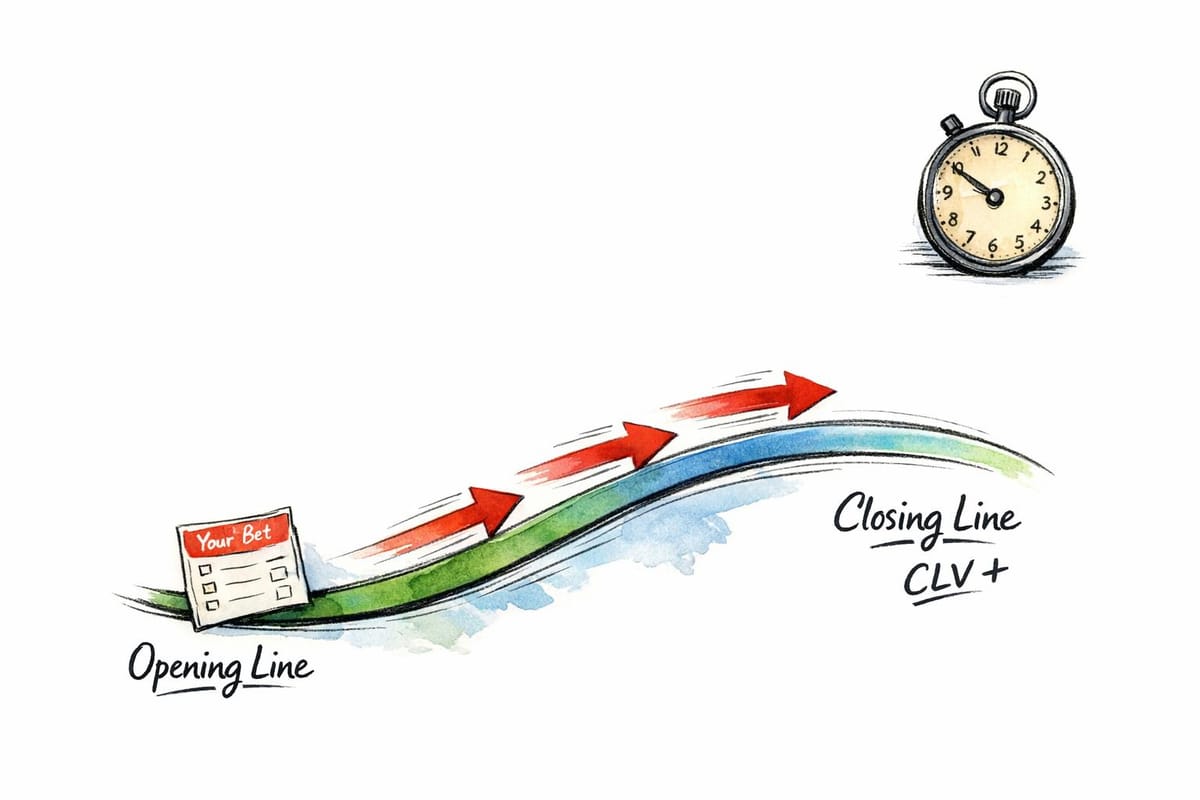
Closing Line Value (CLV) measures the difference between the odds you bet on and the final odds just before the game starts. It's a crucial metric for evaluating your betting strategy and long-term profitability. Beating the closing line consistently shows you're identifying value before the market fully adjusts, which is a strong indicator of skill.
Key Takeaways:
- Positive CLV: Your odds are better than the closing odds (e.g., betting on +150, closing at +130).
- Negative CLV: Your odds are worse than the closing odds (e.g., betting on -7, closing at -5.5).
- Why It Matters: Consistently achieving positive CLV can lead to higher ROI, even if short-term results vary.
- How to Track: Log your bets, compare your odds to sharp sportsbooks, and calculate CLV for spreads, totals, and moneyline bets.
- Improving CLV: Bet early on opening lines, compare odds across sportsbooks, and monitor line movements to identify inefficiencies.
CLV isn't just about winning individual bets - it's about consistently outsmarting the market for long-term success.
What Is Closing Line Value (CLV) in Sports Betting?
Positive vs. Negative Closing Line Value
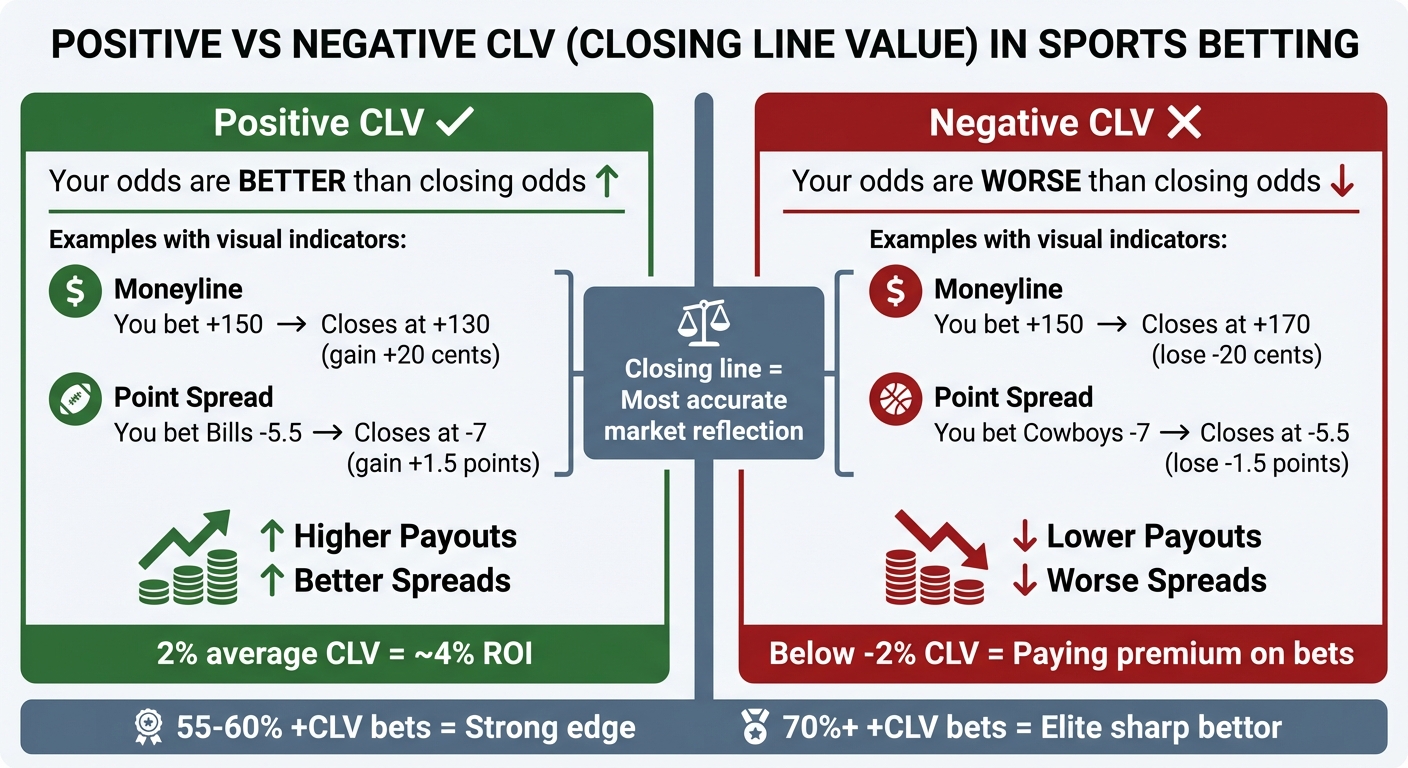
Positive vs Negative CLV: Understanding Closing Line Value in Sports Betting
What Is Positive CLV?
Positive CLV happens when the odds you bet are better than the final market odds at kickoff. For instance, if you bet on the Denver Broncos at +150 (moneyline) or the Buffalo Bills at -5.5 (point spread), and the closing odds shift to +130 and -7 respectively, you've secured positive CLV. This means you either get a higher payout or a more favorable spread.
This edge becomes more impactful over time. The closing line is considered the most accurate reflection of all available information. So, if you consistently beat it, it shows you're spotting value before the market fully adjusts. In highly competitive markets like the NFL, even a small edge - say, a 1% to 2% CLV on sides or totals - can indicate top-tier betting performance.
What Is Negative CLV?
Negative CLV occurs when your bet is placed at odds worse than the closing line. For example, if you bet on the Dallas Cowboys at -7 early in the week, but by kickoff, the line moves to -5.5, you're now betting on a less favorable margin. Similarly, if you wager at +150 but the closing odds shift to +170, you're settling for a lower payout.
Over time, this pattern can significantly hurt profitability. Bettors with an average CLV below -2% are essentially paying a premium on their bets, making it much harder to overcome the sportsbook’s built-in margin (the vig). Seeing this in real-life betting scenarios makes the concept even clearer.
CLV Examples
| Bet Type | Your Odds | Closing Odds | CLV Result |
|---|---|---|---|
| Moneyline | +150 | +130 | Positive (+20 cents) |
| Moneyline | +150 | +170 | Negative (-20 cents) |
| Point Spread | Bills -5.5 | Bills -7 | Positive (+1.5 points) |
| Point Spread | Cowboys -7 | Cowboys -5.5 | Negative (-1.5 points) |
Even small differences in CLV can have a big impact on long-term success. The table shows how slight advantages in CLV can lead to better returns. For instance, maintaining a 2% average CLV across all bets could translate to roughly a 4% ROI, which could turn a breakeven bettor into a profitable one.
How to Calculate and Track CLV
Calculating CLV for Point Spreads and Totals
To calculate CLV for point spreads and totals, use this formula: CLV = Bet Line – Closing Line. Here's an example: if you bet on the Bills at -5.5 and the line closes at -7, your CLV is +1.5 points. On the flip side, if you bet on the Cowboys at -7 and the line closes at -5.5, your CLV is –1.5 points (calculated as –7 – (–5.5)). The bigger the positive difference, the better your edge. For reliable closing lines, sharp sportsbooks like Pinnacle, Circa, or BetOnline are excellent benchmarks since their markets often reflect true probabilities.
Calculating CLV for Moneyline Bets
For moneyline bets, you’ll first need to convert odds into percentages. Use this formula:
CLV% = (Closing Odds / Your Odds – 1) × 100.
Let’s break it down with an example:
-
If you bet at +150 (2.50) and the line closes at +130 (2.30), the calculation is:
CLV% = (2.30 / 2.50 – 1) × 100 = –8%. -
Conversely, if you bet at +130 (2.30) and the line closes at +150 (2.50), your CLV% is:
CLV% = (2.50 / 2.30 – 1) × 100 = +8.7%.
The same principle applies for favorites. For instance, if you bet at -110 (1.91) and the line closes at -130 (1.77), the formula gives:
(1.77 / 1.91 – 1) × 100 ≈ –7.3% CLV.
A consistent CLV average of 2% to 5% is an excellent indicator of long-term profitability.
Tracking CLV Over Time
The real value of CLV becomes apparent when you track it across multiple bets. To do this, log key details like the date, sport, bet type, odds, closing odds, stake, and outcome. You can also add a "CLV Score" column to classify each bet as:
- +CLV (you beat the line)
- –CLV (you lost value)
- 0 CLV (you matched the market)
Bettors who outperform the closing line on 55% to 60% of their bets show a strong edge, while elite sharp bettors can hit 70% or more. However, even with a 3% edge over 100 bets, there’s still a 25% chance of ending up in the red due to variance. This is why CLV is a more reliable performance metric than short-term profit.
Another insight: bets placed more than 24 hours before an event typically gain an average CLV of +1.2%, while those placed in the final hour often see an average loss of –0.5%. By tracking these trends, you can identify the best times to place your wagers and evaluate whether your betting approach is improving. Over time, these patterns can help you refine your strategy and consistently achieve positive CLV.
How to Achieve Positive CLV
Securing a positive CLV (Closing Line Value) relies on smart strategies like timing your bets effectively and analyzing market trends to gain an edge.
Bet Early When Lines Open
When sportsbooks release opening lines, they often reflect incomplete market data, leading to potential pricing errors. For example, NFL odds typically appear on Sundays, while NBA and NHL lines are posted the night before. These early lines are more prone to inaccuracies, which the market quickly adjusts. Jumping on these initial inefficiencies can give you an advantage.
While major markets like NFL spreads are highly efficient, smaller markets - such as player props or lesser-known leagues - tend to offer more opportunities. Acting quickly on factors like injury updates, weather changes, or rest schedules can also help you capture better odds before the public reacts. Once you've identified these early opportunities, compare odds across multiple sportsbooks to ensure you're getting the best value.
Compare Odds Across Sportsbooks
Having accounts with 3–5 sportsbooks is a smart way to secure the best possible odds before the market catches up. This process, called line shopping, is essential for improving your CLV. Even a small difference, like half a point on a spread or a few cents on a moneyline, can significantly impact your long-term results.
To maximize your advantage, compare odds from sharp sportsbooks like Pinnacle, Circa, or BetOnline with those from recreational books such as DraftKings or FanDuel. Recreational books often lag in adjusting to new information, offering opportunities to capitalize on market delays.
Track Line Movement
Beyond comparing odds, keeping an eye on line shifts is key to spotting short-lived market inefficiencies. Watching how odds evolve over time helps you identify when sharp money is influencing a line. A strategy known as steam chasing involves noticing a line shift at a sharp sportsbook and quickly betting at a slower-moving book.
Instead of focusing solely on the outcome of a single bet, professional bettors prioritize the price they locked in compared to the final market line. To refine your timing, use real-time alerts and review your betting history to understand when your wagers have been most effective. This approach ensures you're always aiming for the best possible value.
Using WagerProof to Improve Your CLV
WagerProof simplifies the process of tracking Customer Lifetime Value (CLV) by integrating real-time professional data with AI tools. These tools are designed to identify value before the market adjusts, giving you a competitive edge.
AI Research Agents for CLV Analysis
WagerProof's AI agents are like having a personal analyst for your bets. They evaluate matchups, monitor line movements, and spot pricing inefficiencies. You can fine-tune these agents using over 50 customizable parameters, such as risk tolerance, preferred sports, and betting style, to align with your specific strategy. These agents then generate clear, data-backed picks by comparing current odds with likely closing lines. All of this feeds directly into WagerProof's real-time data suite, ensuring you stay informed.
Access to Real-Time Betting Data
The Edge Finder tool scans sportsbooks for stale lines and flags reverse line movements (RLM), steam moves, and bet-to-dollar imbalances. On top of that, WagerBot Chat offers plain-English responses to your queries, combining odds, injury updates, weather conditions, and predictive models into a comprehensive analysis. By removing the sportsbook margin from closing lines, the platform calculates no-vig fair values, giving you a more accurate benchmark for evaluating your CLV.
Track Your Betting Performance
WagerProof doesn't just provide insights - it helps you refine your strategy over time. It logs every detail of your bets, including timestamps, odds, and closing lines, while tracking key metrics like ROI, win rate, Brier Score, and Log Loss. With rolling visualizations of your performance trends, you can pinpoint the markets where you're consistently achieving positive CLV.
| Feature | Insight Provided | CLV Benefit |
|---|---|---|
| Edge Finder | Real-time line discrepancies | Identifies +EV opportunities before lines close |
| WagerBot Chat | Live professional betting data | Separates sharp money from public trends |
| Automated Alerts | Steam moves & RLM | Alerts you to act quickly on market shifts |
| Metric Dashboard | CLV, ROI, Brier Score, Log Loss | Confirms if your betting model has an edge |
Conclusion
Closing Line Value (CLV) stands out as the most dependable way to evaluate betting skill over time. Unlike win rates or short-term ROI, which are often swayed by luck and variance, CLV focuses on the quality of your betting process itself. Even with a solid 3% edge on every bet, there's still a 25% chance of being in the red after 100 bets. This highlights why CLV is so essential for long-term success.
"CLV is the single best predictor of long-term betting profitability, more reliable than short-term win rate." - Bet Hero
The reasoning is straightforward: consistently achieving positive CLV ensures long-term profit, thanks to the law of large numbers. This is why professional syndicates and sharp sportsbooks rely on CLV to identify skilled bettors and separate them from those riding on luck. For example, maintaining an average CLV of 2% across your wagers can translate to an approximate 4% ROI in traditional betting markets.
To leverage this, focus on consistently securing better prices than the closing line. Use sharp benchmarks like Pinnacle or Circa as your reference points, and don't let short-term losing streaks distract you. Aiming for a positive average CLV of 2–5% is far more valuable than chasing temporary wins or losses. The closing line reflects the most accurate probability of an event because it factors in all relevant data. Your goal isn’t just to pick winners - it’s to outsmart the market by beating the price.
WagerProof's tools, such as AI research agents, Edge Finder, and automated tracking, are designed to help you uncover value before the market adjusts. They also allow you to verify whether your betting model has a real edge. By tracking CLV across a large sample of bets and refining your strategy based on the data, you can let the numbers validate your skill. This method reinforces the idea that CLV isn’t just a metric - it’s the cornerstone of a betting process that prioritizes long-term profitability over short-term variance.
FAQs
What’s the best sample size to judge my CLV?
To get a reliable measure of your CLV, aim to analyze a sample of about 200 bets. If you consistently beat the closing line in more than 55% of those bets, it’s a strong indicator that you may have a real edge and the potential for long-term success.
Which closing line should I use as the benchmark?
When placing a bet, pay attention to the odds available at the time. Then, compare those odds to the final market odds right before the event begins. If you consistently secure better odds than the closing line, it’s a clear sign you have a betting edge. This can be a strong indicator of potential long-term profitability in your betting strategy.
Can I have positive CLV and still lose money short-term?
Having a positive CLV shows that you're making decisions with better odds than the market, which points to long-term success. But it doesn't guarantee short-term profits. That's because short-term results are heavily influenced by factors like variance and luck. Even with a positive CLV, you can still experience losses in the short run.