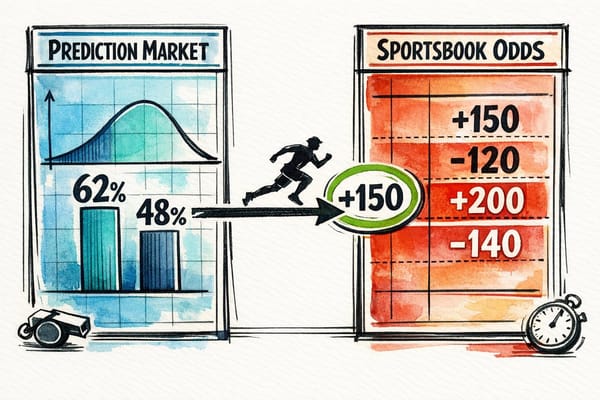
Prediction Markets vs. Sportsbook Odds
How prediction markets differ from sportsbook odds—pricing, fees, probability accuracy, and spotting mismatches to find value and hedge bets.
How prediction markets differ from sportsbook odds—pricing, fees, probability accuracy, and spotting mismatches to find value and hedge bets.
CFTC says it can police designated contract markets after Kalshi reported two insider trading cases.
Kalshi sues Utah officials, arguing federal CFTC oversight preempts state gambling enforcement of its prediction markets.
How AI analyzes betting behavior to flag risky patterns, enable early intervention, and support responsible gambling.

Adaptive retraining improves prediction accuracy but complicates historical benchmarks; use calibration, NLL and real-time validation to avoid collapse.

Purged cross-validation plus walk‑forward backtesting reveals whether betting models truly generalize — CV finds overfitting, backtesting verifies ROI and risk.
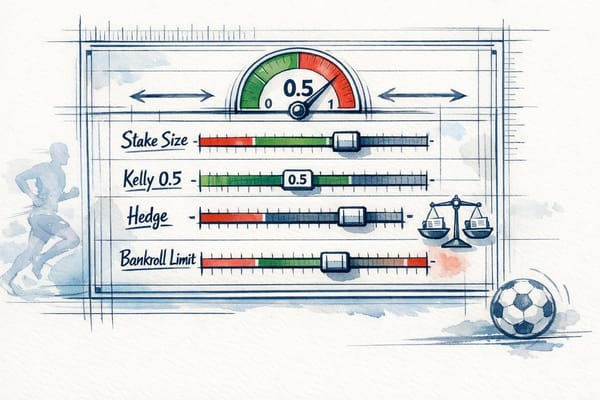
Clear live-betting rules for stake sizing, fractional Kelly, hedging, and bankroll limits to control emotion and manage in-play risk.

Why ROI—not hit rate—determines betting success: odds, value bets and calibration drive real profitability, not raw win percentage.

Step-by-step checklist for using NLP in sports betting: collect and clean data, track sentiment and odds, find value bets, backtest and validate.

Why public bettors often lose, how consensus models improve predictions, and where mismatches create value bets for profitable sports wagering.
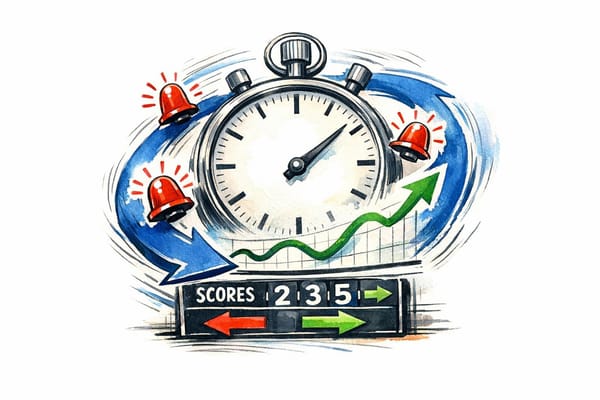
Real-time drift alerts tied to automated retraining minimize model decay and downtime, keeping sports-betting predictions reliable.

How AI assigns Possession Value to every action using tracking, EPV, xT and pitch-control to reveal hidden player impact and live betting insights.